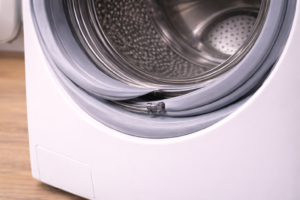
Replacing a washing machine door seal usually resolves leaks caused by cracks, tears, or worn rubber. However, in some cases, water may continue leaking even after a new gasket has been installed.
When this happens, the issue is often related to installation or fit rather than a defective new part.
The Seal Is Not Seated Evenly
The door seal must sit evenly around the entire drum opening. If one section is slightly twisted, folded incorrectly, or not fully pressed into its groove, the gasket may fail to seal properly.
Signs of uneven seating include:
-
A section of rubber that appears raised
-
Minor gaps between the seal and the drum rim
-
Leaks occurring from one consistent spot
Even a small misalignment can allow water to escape under pressure.
The Retaining Band Is Not Secured Properly
Door seals are held in place by one or two retaining bands. If the inner or outer band is not tightened correctly, the gasket may shift during operation.
Possible issues include:
-
A loose clamp
-
A retaining spring not fully engaged
-
A band positioned slightly off-centre
If the seal moves during spinning, water may escape from the front.
Incorrect Model or Aftermarket Fit
Using a seal that is not specific to the exact washer model can cause fit problems. Even slight dimensional differences can affect how the gasket compresses against the door glass.
When purchasing a replacement seal, it is important to confirm:
-
The exact model number of the washer
-
Compatibility of the replacement part
-
Proper alignment markers (if present)
A poorly fitted seal may leak even if it appears visually intact.
The Seal Is Twisted During Installation
During installation, the rubber can become slightly twisted inside its groove. This may not be obvious when the door is open but can prevent full compression when closed.
Carefully checking the entire circumference of the gasket for smooth, even placement can help identify this issue.
Drum or Door Alignment Issues
In rare cases, the leak may not be caused by the seal itself. If the drum is misaligned or the door hinge is slightly off, the seal may not compress evenly.
This can result in:
-
Persistent leaking from the same area
-
Visible uneven contact between seal and door glass
If structural alignment issues are suspected, professional inspection may be necessary.
What to Do if a New Seal Leaks
If a new seal continues to leak:
-
Inspect the entire gasket for even seating.
-
Check that retaining bands are properly secured.
-
Confirm the replacement part matches the washer model.
-
Run a short cycle while observing the leak location.
In many cases, minor adjustments resolve the issue.
If problems persist and other mechanical concerns are present, you may need to consider whether further repair is practical. When a Door Leak Means It May Be Time to Replace the Washer discusses this decision.
For a complete overview of door seal leak causes and what to check first, see Washing Machine Door Seal Leaking: Causes and What to Check First.
A Practical Approach
A new door seal should eliminate leaks caused by worn or damaged rubber. If leaking continues, installation or alignment issues are often responsible.
Carefully reviewing the fit and positioning of the gasket can often resolve the problem without additional parts. Taking a methodical approach helps ensure the new seal functions as intended.